Inside DeepSeek's DSpark: How Speculative Decoding Speeds Up LLM Inference Without Losing Quality
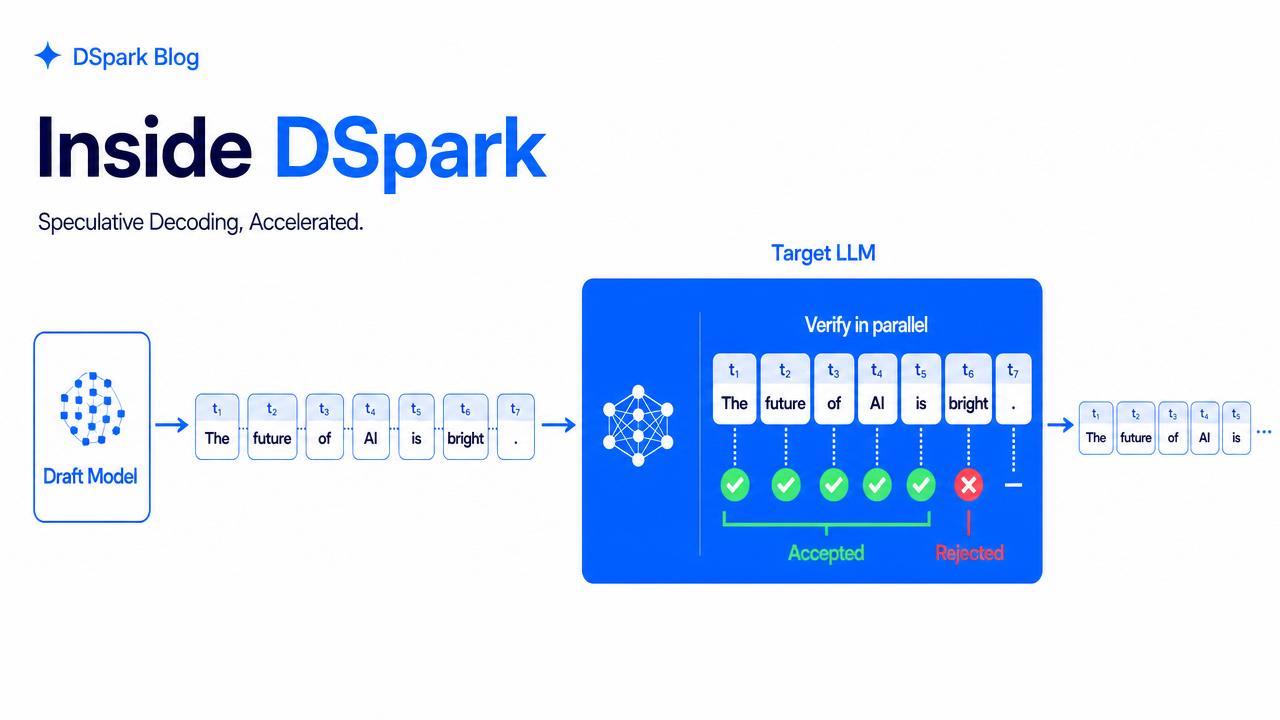
In short: DSpark is DeepSeek's speculative decoding engine. It pairs a small semi-autoregressive drafter with a confidence head and a hardware-aware scheduler to make LLM inference 60–85% faster per user and up to ~6.6× higher throughput — with output that is byte-for-byte identical to the target model.
Serving a large language model at scale is a bandwidth problem more than a compute problem. During generation the GPU spends most of its time reloading weights from memory to produce a single token, then doing it all again for the next one. The arithmetic units sit idle. Every serious inference-speed technique is really about getting more useful tokens out of each memory load.
Speculative decoding is the cleanest answer we have to that problem, and DSpark is DeepSeek's production implementation of it — the piece that pushes V4-Pro and V4-Flash into the 120-tokens-per-second range without changing a single weight of the served model. For a broader primer on the technique itself, see how speculative decoding makes LLMs faster without retraining. Here is what is inside it.
The idea in one paragraph
A small, cheap draft model guesses a block of upcoming tokens. The big target model you actually want to serve verifies all of them in a single forward pass. You keep the longest correct prefix for free, stop at the first wrong guess, let the target correct it, and continue. Rejection sampling on the logits guarantees the distribution is unchanged — the final text is byte-identical to what the target would have produced alone.
The governing equation of every variant:
Time per token ≈ (draft time + verify time) ÷ accepted tokens per round
You win when the drafter is cheap and accurate, and when the number of accepted tokens per round stays high. Every DSpark design choice targets one of those three terms.
The drafter dilemma DSpark solves
The industry has been stuck between two bad options for the drafter:
- Autoregressive drafters (a smaller LLM generating tokens one by one) are accurate but slow — the draft cost itself eats the speedup.
- Parallel drafters like Medusa emit all positions at once from a shared hidden state. Fast, but they suffer from suffix decay: position 1 is fine, position 2 is okay, position 5 is essentially a coin flip, because later tokens are not conditioned on earlier ones.
DSpark's drafter is semi-autoregressive. A parallel backbone proposes candidates cheaply, then a tiny serial Markov head — small enough that it does not blow the latency budget — rewrites each later position conditioned on the earlier ones. The result is Medusa-class speed with much better deep-position accuracy, which directly raises the "accepted tokens per round" term.
The confidence head: don't verify what will fail
Even a good drafter emits some drafts that are obviously going to be rejected. Verifying them anyway means paying the target-model forward pass for nothing.
DSpark adds a lightweight confidence head that scores each candidate before it reaches the verifier. Drafts below a threshold are dropped and the round falls back to a shorter, safer draft. Under load, dropping doomed drafts is a bigger win than adding more drafts — it protects the verifier's time.
The hardware-aware scheduler
Speculative decoding has a fixed-cost problem: every rejected token wasted a verify slot. The optimal draft length depends on how much spare verifier capacity you actually have, which in a real cluster changes second by second with concurrent requests.
DSpark's scheduler watches the GPU load and adapts draft length dynamically. When the verifier has slack it drafts longer and eats the bandwidth. When the cluster is saturated it drafts shorter, so rejected tokens cost less. The stated result: per-user speed stays near its peak and aggregate throughput holds — DeepSeek reports up to ~6.6× throughput at a 120 tokens/second latency floor on V4-Pro and V4-Flash.
What the numbers actually mean
The headline "60–85% faster" is per-user generation speed, on the same GPUs, with the same model weights, producing the same text. That is the important framing:
- No retraining. DSpark is attached to a frozen target model; only the draft head is trained.
- No quality trade-off. Rejection sampling guarantees the output distribution is preserved.
- No new hardware. The speedup comes from using bandwidth the GPU was already paying for.
Open source and portable
DSpark and the accompanying DeepSpec training and evaluation codebase are MIT-licensed. The draft head is not specific to DeepSeek's model family — DeepSeek publishes draft checkpoints that work on Qwen and Gemma, and the training recipe is documented so teams can build drafters for other targets.
For serving teams, the practical takeaway is that a bandwidth bottleneck you thought was a hardware ceiling is really a scheduling problem. DSpark is one concrete way to reclaim it.
FAQ
Is DSpark lossless?
Yes. It is a speculative decoding system, so the target model verifies every draft token. The final output is byte-for-byte identical to what the target would have produced.
How is it different from Medusa or EAGLE?
Medusa-style parallel drafters suffer from suffix decay. DSpark's semi-autoregressive drafter adds a small serial Markov head that conditions later positions on earlier ones, keeping deep-position accuracy high.
What does the confidence head do?
It scores how likely a draft is to be accepted. Low-confidence drafts are discarded before verification so the GPU never wastes a forward pass on a draft that would fail.
How much faster in production?
60–85% faster per-user generation, and up to ~6.6× higher throughput while holding a 120 tokens/second latency floor on DeepSeek's V4-Pro and V4-Flash serving stacks.
Is it open source?
Yes — MIT-licensed, with draft heads that also work on Qwen and Gemma.